Sunday, 20 November 2016

Scars

Scars by Chris Wraight is the twenty-eighth installment in the Horus Heresy series. It follows the White Scars Legion as they enter the war and are faced with the choice of who to side with: Horus or the Emperor?

Scars is Chris Wraight's first novel for the series, but that is slightly misleading as Scars was not originally published as a novel; it debuted as a downloadable serial told in twelve parts. Collected together into one story, those parts chronicle the emergence of the elusive and mysterious White Scars onto the Heresy stage. The first half of the novel also features the Space Wolves as they are set upon by the Alpha Legion whilst licking their wounds from Prospero, and it is this conflict around which the fate of the White Scars pivots. Faced with contradictory calls for aid, each side naming the other traitor whilst an Alpha Legion fleet silently confronts his own, primarch Jaghatai Khan chooses neither side and strikes out with his Legion to find the truth for themselves, leaving the Wolves to fight the Alpha Legion alone.

In terms of writing style, Scars is a novel much like its Legion: fast, flashy and shallow. The plot moves along nicely and the battle scenes are satisfyingly intense, but there is little in the way of detail or complexity. The main protagonist, Shiban Khan, is an archetypal White Scar captain, while more interesting is his opposite number, Torghun Khan, a wannabe Son of Horus who doesn't fit in to his assigned Legion. Chris Wraight creates other good characters, including Departmento Munitorium officer Ilya Ravallion who takes on the impossible task of organising the Legion, and the Scars' head Stormseer, Targutai Yesugei, who starts the novel in self-imposed exile on Chogoris but sets out to rejoin his legion with the aid of some Shattered Legions survivors. However, Scars only paints these people in broad strokes, preferring to move the plot along rather than linger over character development. This lowers the emotional stakes when Shiban and Torghun confront each other, each representing one side of a civil divide that splits the White Scars into pro-Horus and pro-Imperium camps. More interesting is the Legion's unexpected return to Prospero, whose ruined surface Jaghatai Khan walks and nearly dies on in order to discover the truth of the Heresy.

Overall Scars is a good novel that makes up in dynamism what it lacks in depth. The final scenes on Prospero and the civil war-torn Legion fleet are dramatic and engaging, leading to the predictable but satisfying conclusion of the loyalists triumphing and the White Scars remaining loyal to the Emperor.

Limited-edition novella review: Brotherhood of the Storm 
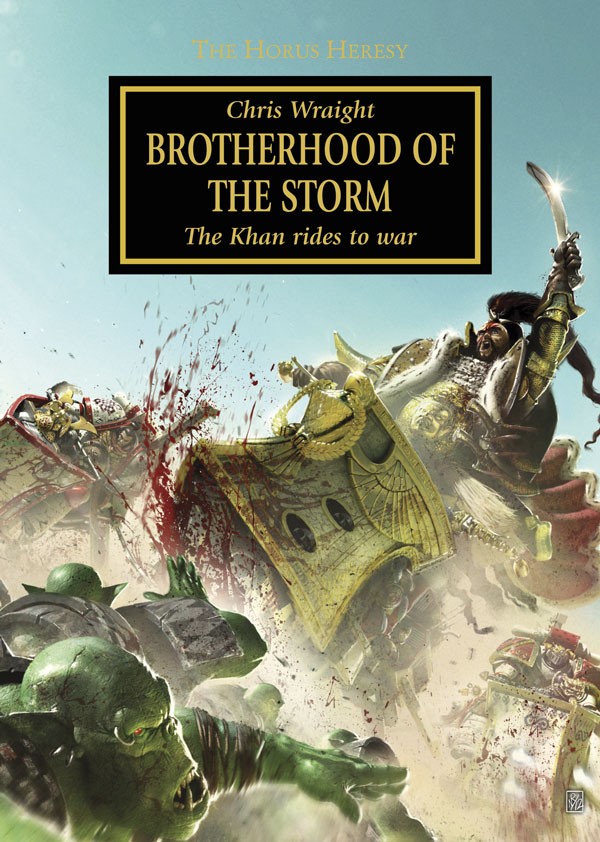
Every now and then Black Library decide to raise revenue by releasing a Horus Heresy story as a limited-edition novella, printing a small number of copies and charging exorbitantly for each. These novellas are then given mainstream release years later, finally making the available to the vast majority of fans. Brotherhood of the Storm by Chris Wraight was the third of these novellas released, and follows the White Scars as they wage war against Orks on the planet Chondax. 

Though ostensibly a chronicle of the final battle in the war for Chondax, Brotherhood of the Storm is actually a novella about four characters, and is all the better for it. Here we are introduced to Shiban of the White Scars, Chogorian native and Khan of the Brotherhood of the Storm, who leads his men in sumptuously flamboyant battle scenes as they hunt down retreating Orks. However, two cultures collide when they link up with the Brotherhood of the Moon, lead by Terran-born Torghun Khan. Shiban's relentless forward assaults gel badly with Torghun's methodical war making, but by the end of the novella both men learn something from each other. 

The other characters driving Brotherhood of the Storm are Ilya Ravallion, a logistics officer sent to organise the flaky Scars in the aftermath of Ullanor, and Targutai Yesugei, the Legion's wise master Stormseer. Ilya injects humanity into the narrative, and Targutai's flashback to his boyhood trials on Chogoris is the best scene in the novella. Each of these characters, however, revolves around the elusive majesty that is Jaghatai Khan, primarch of the White Scars, who leads his men to final victory in the Ork-infested canyons of Chondax. Brotherhood of the Storm is an excellent novella that packs riveting action and considered character development into a small page count, and it is also a fantastic introduction to Scars.   

Wednesday, 16 November 2016

Nemesis

Nemesis by James Swallow is the thirteenth installment in the Horus Heresy series. It follows two assassination missions, one by a strike team of Imperial Assassins sent to kill Horus, the other by a daemonic entity named Spear sent to kill the Emperor.

Nemesis is an interesting departure for the Heresy series, in that it features very few Space Marines, foregrounds human characters and tells the story of shadowy covert ops taking place far from the main theatres of war. It is also the closest the Heresy series comes to being a police drama; one of the early protagonists, Yosef Sabrat, is a law officer on the planet Iesta Veracrux who investigates a string of grisly murders. Nemesis's tone is bleak, even for the Heresy series, and in many ways its horrors foreshadow the grim darkness of the forty-first millenium. Its plot, while interesting, is ultimately a side-show to the main story, and for me this makes it one of the less notable Heresy novels.

The main plotline of Nemesis follows a team of Imperial Assassins put together and sent on a mission to assassinate Horus. The team's leader and novel's main protagonist is Eristede Kell, a grim Vindicare sniper, and he is joined by five others: Koyne, an arrogant Callidus shapeshifter; the Garantine, a brutal Eversor butcher; Iota, a cloned Culexus Pariah; Fon Tariel, an inexperienced Vanus Infocyte; and Jenniker Soalm, a Venenum poisoner and Eristede's sister. Each of the six is introduced in an extended recruitment montage, which is one of the book's most enjoyable sections. However, a large part of the book also follows Yosef Sabrat as he investigates a string of murders committed by Spear, a monstrous Black Pariah bonded to the skin of a daemon, and it here that the plot gets very dark. Spear's kills are gut-churningly gory and James Swallow doesn't shy away from the details, nor from brutally killing most of his characters as Spear murders and assimilates them one by one. Spear's ultimate mission is to kill the Emperor, but to do so he needs the drop of the Emperor's blood preserved on House Eurotas's Warrant of Trade. Throughout the book he works and kills his way towards this goal, ultimately becoming such a threat that the assassin team divert to take him down.

For the six assassins, their mission to kill Horus takes them to Dagonet, a planet neighbouring Iesta Veracrux that is in the throes of falling to the Warmaster. In order the complete their mission the team aid the loyalist resistance, forcing Horus to come to Dagonet in person, but are foiled when Horus sends Luc Sedirae to impersonate him and the they assassinate the Sons of Horus 13th Captain instead. Jenniker and Iota go off on their own mission to protect the Warrant of Trade and are both killed by Spear, while the Garantine sacrifices himself so that Eristede, Tariel and Koyne can escape. Tariel's own foolishness gets him killed by Spear and Koyne falls the monster as well, before Eristede finally puts him down and makes a suicide run at Horus's flagship in a desperate last bid to complete his mission. The two assassination missions cancel each other out and both end in failure, though stopping the sheer horror that is Spear seems like victory enough.

Nemesis is by no means a bad novel, it is well-written and tightly plotted, but the story is too bleak and convoluted for my taste and overall the events have little effect on the main series plot. Readers of the series can take it or leave it.

Thursday, 10 November 2016

Eye of Terra

Eye of Terra, edited by Laurie Goulding, is the thirty-fifth installment in the Horus Heresy series. It is an anthology of fifteen previously published short stories by eleven authors, and also includes the novella Aurelian.

David Annandale's Iron Corpses is set in the aftermath of the Battle of Tallarn, and follows an Iron Warrior Warsmith as he hijacks a loyalist Titan in order to survive the irradiated wastelands.

Aaron Dembski-Bowden's Massacre was originally published in segments on the Black Library website, and follows the characters from his Night Lords series during the events of the Isstvan V Dropsite Massacre. The Long Night takes place during Sevatar's imprisonment aboard the Invincible Reason, and sees him befriend one of the ship's Navigators and escape in order to kill another Navigator who beat her.

Matthew Farrer's Vorax is his first story for the Heresy since After Desh'ea. It follows a traitor Mechanicum being who is killed by deadly Vorax constructs.

John French's The Eagle's Talon was originally paired as an audio drama with Iron Corpses. Told through a non-linear sequence of vox recordings, it follows a strike team of Imperial Fists as they infiltrate and bring down an enemy ship during the Battle of Tallarn.

Guy Haley's The Final Compliance of Sixty-Three Fourteen follows the Imperial Governor of a world brought to compliance by the Luna Wolves who is faced with Horus's return and his demands to join in his rebellion.

Nick Kyme's Red-Marked chronicles the founding of Aeonid Thiel's Red-Marked squadron, forged in battle as they foil a plot by Word Bearers and World Eaters dregs left over from the Shadow Crusade. Stratagem depicts Thiel's first meeting with Roboute Guilliman since Calth and reveals Thiel's influence on the proto Codex Astartes.

Graham McNeill's The Wolf of Ash and Fire features Horus and the Emperor fighting side-by-side against an Ork empire prior the Heresy, and a point-of-view from Hastur Sejanus as he leads his squad to Horus's rescue after he falls down a chasm at the heart of the Ork junk-asteroid.

Rob Sanders' Ironfire features the return of Idriss Krendl after his crippling in The Iron Within, as he tests a new siege tactic against a fortress of Emperor's Children using two of the siege cannons gifted to Perturabo by the Lion.

Andy Smillie's Sins of the Father features Sanguinius brooding on the fate and character of Amit and Azkaellon as they duel. The Herald of Sanguinius describes the selection ritual to decide the first Sanguinor during the time of the Imperium Secundus.

Gav Thorpe's Inheritor follows the actions of Eliphas the Inheritor on Kronus during the Shadow Crusade, linking to the Dawn of War game Dark Crusade. Master of the First was originally paired as an audio drama with The Long Night, and follows Astelan of the Dark Angels as he sets up and then turns against an anti-Luther uprising on Caliban.

Chris Wraight's Brotherhood of the Moon joins Allegiance in being a sequel to Scars, and follows Torghun Khan as he faces trial for his traitorous actions in that novel.

Angels of Caliban

Angels of Caliban by Gav Thorpe is the thirty-eighth installment in the Horus Heresy series. It follows two branches of the Dark Angels Legion, those in the Imperium Secundus as they go to extremes in the hunt for Konrad Curze, and those on Caliban as various factions manoeuvre for power.

Angels of Caliban is the Dark Angels novel I've been waiting for since Fallen Angels, and Gav Thorpe did not disappoint. The basics of the Imperium Secundus are well-established by this point in the series but Gav manages to present a new take on it, foregrounding the tensions between co-rulers Jonson, Guilliman and Sanguinius and writing Angels of Caliban as much like a political drama as a war novel. Caliban, on the other hand, has been out of the series' eye for a while now and Gav returns to it in triumph, weaving together a complex plot of scheme and counter-scheme as secret rebels Luther, Astelan and Zahariel pursue their separate agendas. Both plots are tense and engaging, but I found myself more drawn to the events on Caliban because they were a completely new segment of the story, revealing that there was much more to Caliban's rebellion than simply Luther's fall.

One of Angels of Caliban's biggest selling points was that it reveals hidden secrets about the history and traditions of the Dark Angels, and Gav Thorpe has done something very different in regards to this by exploring the ancient history of the Space Marines. Through Astelan's memories, readers learn that the Dark Angels Legion existed in a different form before any of the other Legions were made, as an army of the very first Space Marines that was divided into specialist battlegroups called 'wings' and commanded by the Emperor himself. These 'Angels of Death' became the First Legion after the other nineteen were created and then the Dark Angels after discovering Lion El'Jonson on Caliban, but the 'wings' system was preserved and continues to exist, marines from different wings scattered across the companies but ready to form into their battlegroup when the command is given. Most prominent in Angels of Caliban are the Dreadwing, who specialise in total war and have access to archaic and devastating weapons. Their methods prove to be the undoing of the Imperium Secundus, when with the Lion's sanction they breach a rule made by Sanguinius and go to extremes in order to hunt down Konrad Curze, who is loose on Macragge. The final battle sequence between the Lion and Curze is epic, and I derived great satisfaction from Jonson beating Curze into submission, but Angels of Caliban makes it clear that in his own way Jonson is just as bad a villain as Curze, and his actions destroy the alliance that held the Imperium Secundus together.

Events are no less drastic on Caliban, where the fist ever visit by loyalist Dark Angels throws the rebel Angels into a frenzy of scheming. The novel provides us with a welcome return to Zahariel, a character we haven't seen for twenty-seven books, who becomes enthralled to the Chaos power buried beneath Caliban and is well on the way to becoming a Chaos sorcerer by the story's end. Just as interesting is the character of Astelan, who sided with Luther's rebellion because he hates the Lion and the changes he has made the Legion but holds no loyalty to Luther and considers himself a loyal warrior of the Emperor, believing that the Dark Angels should return to the old days when they were the Angels of Death. All the scheming comes to fruition with Caliban formally declaring its rebellion, and the revelation of a long-held secret as one of the characters becomes the new Lord Cypher.

Angels of Caliban is a fantastic novel, full of intrigue, drama and revelations. and it has repercussions not just for the Horus Heresy but the entire 40K universe. It is absolutely essential reading.
     

Wednesday, 7 September 2016

The Unremembered Empire

The Unremembered Empire by Dan Abnett is the twenty-seventh installment in the Horus Heresy series. It documents the creation of the Imperium Secundus among the five-hundred worlds of Ultramar.

The first thing you need to know about The Unremembered Empire is that it is not really a story so much as a space where lots of unresolved plot threads come together and then are spun off in new directions. In broad terms, Unremembered Empire chronicles the beginning of the Imperium Secundus, a kind of backup Imperium created by Roboute Guilliman who, cut off from the rest of the galaxy by the Ruinstorm, believes that Terra has fallen and the Emperor is dead. Central to this undertaking is the Pharos, a xenos beacon on the planet Sotha that is able to pierce the warp storms and draw scattered loyalists to Macragge. This is where the first of our unresolved plot threads pops up, with loyalist Iron Warrior Warsmith Barabas Dantioch, last seen in The Iron Within, operating the beacon for Guilliman. The activation of the beacon draws in many scattered loyalists, including Alexis Polux and his contingent of Imperial Fists last seen in The Crimson Fist, and, eventually, half of the Dark Angels Legion led by the Lion himself. Guilliman and the Lion form an uneasy alliance, with the Lion more than prepared to annihilate Imperium Secundus if he thinks Guilliman is attempting to usurp the Emperor. However, it is not the Lion but his unwilling passenger who is the biggest threat, as Konrad Curze, trapped in the bowels of the Invincible Reason since Prince of Crows, escapes the ship and makes his way down to Macragge to cause havoc.

The Unremembered Empire is the sequel to many books, including Vulkan Lives. In one of the more bizarre plot threads that the Heresy writers have come up with, Vulkan's teleport at the end of that novel deposits him in the atmosphere above Macragge. His flesh seared away by the heat of re-entry, Vulkan dies again and his corpse crashes into Macragge Civitas. He returns to life in a medical centre but is now completely insane, mind unhinged by the torments he has endured. Other characters from Vulkan Lives arrive on Macragge as well, John Grammaticus sent there by the Cabal to kill Vulkan with the fulgurite and Barthusa Narek following him to steal the weapon for his plot to kill Lorgar. Damon Prytanis, Perpetual assassin last seen in Betrayer, rocks up to ensure John completes his mission, but everything is put on hold when Curze rampages through the Fortress of Hera in a night of blood and death.

The action sequence of Curze marauding through the fortress is the climax of the novel. He almost manages to kill the Lion and Guilliman, but they are saved by Pharos ex machina. A sequence in which he terrorises Guilliman's adoptive mother Euten is clearly inspired by horror movies, but she is saved first by the watch-pack of Space Wolves sent to observe Guilliman and second by insane Vulkan, who breaks out of containment to confront Curze. Their brawl across the rooftops is brutal and visceral, and of course Vulkan dies a few more times. By this point I think Vulkan is just the HH writing team's stress ball, constantly killed and revived for their gratification. Despite all the odds Curze manages to escape, and both he and Vulkan are present for the final scene with Grammaticus, Prytanis and Narek. Vulkan gets killed a few more times, Prytanis deals with Curze by chucking a daemon at him and Grammaticus stabs Vulkan in the heart with the fulgurite, seeming to permanently kill him but in fact sacrificing his immortality so that Vulkan will eventually be resurrected (see Deathfire). Narek, knocked out of the fight by Curze, is caught at the scene and imprisoned by the Ultramarines. Then, just as things are finally winding down, Sanguinius and the Blood Angels arrive and Guilliman and the Lion crown Sanguinius as the new Emperor.

The Unremembered Empire is a fantastic book, even if it stretches credulity at points. Functionally it is like a fist that gathers up a bunch of loose plot threads and clenches them together into a book, something which the Heresy series sorely needed. In terms of entertainment it is engrossing and like all of Dan's work superbly written. For both of these reasons, is it is an absolute must-read for any fans of the Heresy.

Wednesday, 31 August 2016

War Without End

War Without End, edited by Laurie Goulding, is the thirty-third installment in the Horus Heresy series. An anthology, it gathers together twenty-one short stories previously published in the event-exclusive anthologies The Imperial Truth, Sedition's Gate, Death and Defiance and Blades of the Traitor.

In this post I will review those stories from War Without End that were originally published in The Imperial Truth and Sedition's Gate. For a separate review of Death and Defiance and Blades of the Traitor, please go here.

From The Imperial Truth

Hands of the Emperor by Rob Sanders follows a day in the life of Enobar Stentonox, a Custodian Guard rotated to command of the Imperial Palace's security. A crisis arises when the Imperial Fists move an orbital station into the palace's airspace, the two sides working at cross-purposes in their separate attempts to keep the palace secure, and Stentonox ends up invading the station. This is an entertaining little vignette of a particular crisis, but it lacks the detail and dynamism that make some of Sanders' other stories great.

The Phoenician by Nick Kyme is a fluff piece, a few pages describing Ferrus Manus and Fulgrim's fateful duel from the point of view of a dying Iron Hand. The Iron Hand dies and that's it.

By the Lion's Command by Gav Thorpe follows Corswain of the Dark Angels after the events of The Lion, as he negotiates with a neutral planet whilst a Death Guard fleet bears down on him. There is a lot of potential to examine the motivations and allegiances of ordinary people in the face of the Heresy here, but instead the shades of grey are spoiled by a trite black and white ending when the planet comes to Corswain's aid just in time only for him to dismiss them as cowards for not siding with him from the start.

Lord of the Red Sands by Aaron Dembski-Bowden is another fluff piece, this time a few pages of Angron philosophising about war whilst he butchers loyalists on Isstvan III, but it is saved by ADB's writing which is excellent as ever and makes this an entertaining if brief read.  

The Devine Adoratrice by Graham McNeill introduces us to the corrupt Knight House Devine of Molech and its scions Raeven and Albard on the day of their ritualistic bonding with Knights. The manipulations of Raeven's sister Lyx and a terrorist attack provide some drama, but the climax of the piece is glossed over, with Raeven and Albard's bonding ceremony explained in exposition at the end instead of being shown on the page. Still, this is overall a well-written piece that enticingly sets up Vengeful Spirit.

All That Remains by James Swallow follows a handful of Imperial Army troopers, all shell-shocked veterans of encounters with daemons, as they investigate a mysterious power-outage on their refugee ship. Each of the men is interesting in their own way and the little we are shown of their diverse characters is what makes this story entertaining. The most intriguing part, however, is their encounter with a Knight-Errant formerly of the Thousand Sons, who reveals to them their futures as agents of Malcador and turns the ship towards Titan at the end of the story.

From Sedition's Gate

Artefacts by Nick Kyme follows a conversation between primarch Vulkan of the Salamanders and his forge-master T'kell just before Isstvan V. Vulkan, dismayed by Horus's treachery, determines to destroy his arsenal of weaponry so that their power won't fall into the wrong hands. T'kell, desperate to preserve these examples of Vulkan's craft, objects. In the end they compromise, and Vulkan allows T'kell to preserve just seven: the seven artefacts of Vulkan.

The Harrowing by Rob Sanders is a blow-by-blow description of an Alpha Legion strike force taking over a Mechanicum ship. Rob Sanders knows how to write Alpha Legion well and the action is excellent, though sometimes devolves into too much jargon. There is no real narrative significance to this story, but it is a great showcase of the Alpha Legion at their most duplicitous and lethal.

Allegiance by Chris Wraight is a short follow-up from Scars, focused on Revuel Arvida as he adjusts to life among the White Scars. As a healing and adjustment narrative it contains little action and Wraight shoehorns some in for the climax, but it is ultimately pointless and the story would probably have been better without it.

The Laurel of Defiance by Guy Haley follows Captain Lucretius Corvo of the Ultramarines 90th Company, who is due to be honoured for his role in taking down a Word Bearers Titan during the Shadow Crusade. The story moves back and forth between the preparations for the ceremony and the events for which Corvo is being rewarded, blending crisp action with introspective character development. Haley really makes this work, and The Laurel of Defiance is one of the best short stories in the anthology.

Sermon of Exodus by David Annandale is a prologue to The Damnation of Pythos, showing the events that led to the cultists of Davin undertaking their mass exodus. The piece is suitably creepy for a culture steeped in Chaos, and the quality of it reaffirms my suspicion that David Annandale is better at writing short fiction than novels.

Wednesday, 20 July 2016

Deathfire

Deathfire by Nick Kyme is the thirty-second installment in the Horus Heresy series. It follows a group of Salamanders led by Artellus Numeon as they brave the Ruinstorm in order to return Vulkan's body to Nocturne.

As Nick Kyme points out in this novel's afterword, the Heresy series began with a tightly linked trilogy and then expanded into the vast story we know. Recognising that this expansion was dragging at the momentum of the overall plot arc, the High Lords of Black Library decided to begin weaving their novels more closely together, establishing a stronger continuity and mapping out the route to the Siege of Terra. Key to this endeavour is the work of Nick Kyme, who has set about creating a new trilogy within the Heresy, a trilogy that provides continuity by chronicling the fate of the Salamanders within the wider war. This trilogy began in ignominy with Vulkan Lives, which introduced Artellus Numeon and revealed Vulkan's fate after the Dropsite Massacre on Isstvan V, but in Deathfire Kyme's writing lifts as he reveals Numeon's miraculous survival and places him at the head of sixty-six Salamanders attempting a deadly voyage through the Ruinstorm in order to return Vulkan's body to Nocturne.With a heavy focus on faith, Deathfire pits everything from Death Guard to daemons against the Salamanders as they cross the Warp to Nocturne, ending in a climactic battle and a fateful resurrection.

Deathfire is a novel of three parts. The first part is set in Imperium Secundus where Numeon, captured by Word Bearers and rescued by Aeonid Thiel's Red-Marked, comes to believe that Vulkan is not truly dead after his body disappears from its casket and mysteriously reappears in a memorial garden. Gathering a remnant of the Salamanders who have managed to escape Isstvan V and regroup in Ultramar, Numeon leads them on an epic quest to return Vulkan's body to Nocturne in the hope that the magma of Mount Deathfire will resurrect him. Part two takes up the bulk of the book as the Salamanders endure a harrowing journey through the Ruinstorm, plagued by daemons and hunted by Word Bearers and Death Guard. The theme of faith rises to the fore here as Numeon's near obsessive belief in Vulkan's resurrection creates friction among the others, strung along by a series of seemingly miraculous events. Part two is the slowest, and while I appreciate Nick Kyme slowing down to let us get to know his characters he drags the tension out too far, extending one action sequence over nearly a third of the book. However, the twist that Magnus the Red is somehow influencing the events around Vulkan was completely unexpected, and adds another intriguing facet to an already suspenseful series. Kyme's writing is at times vague, but is still a big step up from the monotonously austere Vulkan Lives. Unfortunately, the number of times he uses the phrase 'Vulkan lives' is simply excessive. It drove vulkan lives insane with vulkan lives constant repetition vulkan lives of the vulkan lives vulkan lives vulkan lives.

Deathfire ends satisfyingly enough with a battle on Nocturne itself that sees the end of the Word Bearers and Death Guard and (MAJOR SPOILERS) Numeon sacrificing himself to resurrect Vulkan. The final part seems rushed compared to the middle section and would have benefited from more time, but overall Deathfire is a satisfying read which sits somewhere above the middle of the scale of Heresy novel greatness.

Limited-edition novella review: Scorched Earth 

Every now and then Black Library decide to raise revenue by releasing a Horus Heresy story as a limited-edition novella, printing a small number of copies and charging exorbitantly for each. These novellas are then given a mainstream release years later, finally making them available to the vast majority of fans. Scorched Earth by Nick Kyme was the fifth such novella released, and follows a pair of Salamanders Dropsite Massacre survivors as they search the scarred battlefield for Vulkan. 

I bought my copy of Scorched Earth at the same time I bought Pharos, as proof against it going out of stock, but left it on the shelf until I could get my hands on Deathfire, thinking that a novella about Salamanders searching for their lost primarch would pair well with a novel about Salamanders bringing their primarch's body home. I read it expecting a fluff piece about the aftermath of the Dropsite Massacre. I did not expect it to be what it was: a superbly crafted tale of desperation, fallout and madness.

Scorched Earth is essentially the tale of two Salamanders, Ra'stan and Usabius, on a quest to find Vulkan in the aftermath of the Dropsite Massacre. Part of a desperate group of survivors based in a crashed Stormbird, they make regular forays into the traitor-haunted wastes. The novella is full of tense, dark moments as the pair do whatever it takes to fulfill their mission, such as crushing the throat of a delirious Raven Guard to prevent him from giving away their position and encountering a mad World Eater in a canyon made of skulls. Scorched Earth saves its best twist for the end, however, when Ra'stan discovers the cave Vulkan was teleported away from and his psyche collapses, revealing a twist straight from Fight Club that he and Usabius are one and the same, Ra'stan a Librarian who has succumbed to madness and Usabius his former captain who was killed. Scorched Earth is an excellent novella that epitomises the bleakness of post-Massacre Isstvan and makes me long for more fiction set there. Bravo, Nick Kyme.